This Is What Intersectionality Can Look Like

New York City activists understand intersectionality better than many, and that was definitely on display at last night's rally in Washington Square.

Maybe it's the City's historic and ongoing reputation as a place of immigrants: the home of Ellis Island, Nuyoricans, Spanish Harlem, Chinatown, Little Italy.... Maybe it's the many ways the City has attracted the LGBTQ community: Broadway, Fifth Ave, Stonewall, the Village, SAGE, and the darker side of sex trafficking and LGBTQ homeless communities, too. Maybe it's the City's history as a destination for safe abortions. Maybe it's the City's prominent communities of the Nation, mainstream Islam, Arab immigrant and refugee populations, and the hard, sometimes controversial, work of activists like Imam Feisal Abdul Rauf, Debbie Almontaser and, of course, Linda Sarsour.

What I know about New York City is that, although we are far from perfect, we are arguably ahead of the curve--of the moral arc of the universe, if you will.

As news began to filter out yesterday of Donald Trump's Executive Orders du jour, there was an immediate response by CAIR-NY, the local chapter of the Council on American Islamic Relations. By noon, CAIR-NY had announced an Emergency Rally on social media. By afternoon, it was the Emergency Rally for Muslim and Immigrant Rights, already pitching a bigger tent than just the Muslim community that are CAIR's constituents.

"What Never Happened With Ahmed"

The theme of the January issue of Pilcrow & Dagger is "do-over" and I was reminded of a friendship I turned down in my Peace Corps community. What might have happened if I had let things develop with my student's Uncle Ahmed? I'll never know. (I'm not even sure that was his name!)
Seated one spot away on my left was one of their brothers, a slim, compact young man, not too tall, with short dark hair, neat and clean-shaven. He reached around his sister to shake my hand. “My name’s Ahmed. I’ve just come back from university in England.”

“Let me guess. You were in York.”

Ahmed was speechless for a moment. “How did you know?”

“You have the most perfect, unmistakable York accent I’ve ever heard from a non-native speaker.” Even after studying abroad in England for a year, it was the only English accent I recognized.
Find a sneak peek here, and get the whole story from Pilcrow & Dagger.

I found this publishing opportunity through the Duotrope Weekly Wire email.
Duotrope: an award-winning resource for writers

"The Peace of Iraq’s Mothers"

It should have been depressing, living with forty families from the impoverished Iraqi countryside—ravaged by American-made land mines, littered with the remains of radioactive American bomb casings, and now sprayed with insurgent gunfire and IEDs. I was sure I would be so distraught by the deformities of these children that I wouldn’t be able to look at them, let alone help them.

I volunteered anyway, because I needed to do something for this country that my country had invaded, for these families in need so close to my new Jordanian home.
In 2005, I spent ten days in a hotel with forty Iraqi families. I met the most remarkable women and children (and men!) on that short volunteer assignment. My story of some of these children and their mothers appears in the January 2017 issue of New Madrid Journal, the literary magazine of Murray State College.

Unlike my two previous publications, the poem and "That Other Hijab Story," New Madrid asked for revisions and put me to work with a Murray State creative writing professor. I had forgotten what a pleasure it can be to work with a professional writing teacher to craft something good into something better. So thanks, Allen!

The Winter 2017 edition of New Madrid Journal is now available here!

I found this publishing opportunity through the Duotrope Weekly Wire email.
Duotrope: an award-winning resource for writers

"The Tale of Sajida al-Rishawi"

I imagine many Americans, when they think about terrorism, have definitive ideas of what it means. I imagine its moral implications are clear. I have to imagine because, for me, there is no such clarity. Instead, I am haunted by the face of a small, haggard woman with a simple white hijab and the eyes of a dead woman walking.

On the night of November 9th, 2005, I was settling into bed, a Peace Corps Volunteer in a small Bedouin village in the north of Jordan. A two hour bus ride south, in the capital Amman, four Iraqis strapped with explosives walked into three hotels. Fifty-four people died, mostly Jordanian and Lebanese Muslims. One bomber lived, and a few tense days later, Sajida al-Rishawi was caught.

Very little of that is why Sajida’s small, dark-eyed face and hunched shoulders have haunted my conscience for more than a decade.
I've talked about this moment in history before. It changed the tide of Jordanian public opinion against Al Qaeda, and the woman whose bomb didn't go off haunted me for a decade.

This story is particularly dear to my heart, and I couldn't be more pleased to announce that "Terrorist or Tragedy? My Struggle with the Tale of Sajida al-Rishawi" has been published at Gulf Stream Literary Magazine, the publication of the Creative Writing Program at Florida International University in Miami, Florida. Read it in its entirety online.


I found this publishing opportunity through the Duotrope Weekly Wire email.
Duotrope: an award-winning resource for writers

The Little NGO That Could ... And Does!

Are you, like me, wondering how you can help Syrians today?

This Upworthy list includes a lot of places to donate. After the fiasco in Haiti, I would put the International Red Cross at the bottom of your list, and elevate an organization that was just an afterthought to Upworthy. When it comes to international development, Questscope is a story of an NGO that does it right.

Back in 2008, while I was unemployed in Jordan, I wrote a grant for Questscope. They had been one of many organizations who received about a million dollars each from the United Nations to create an informal education program for Iraqi refugees and Jordanian high school dropouts. Questscope was the only organization to successfully field their project, so at the end of the grant period, the UN came back to them. "This time, do you want forty million, or a hundred million?" they asked.

For all the good it does, the UN is unfortunately an organization too often impeded by a combination of grift and lax oversight. Questscope could easily have taken advantage.

"That Other Hijab Story"

“You weren’t pressured to cover up otherwise?”

“No.” Except for that one time that I never talk about....
A year ago, in the midst of outrage about yet another hijab-related civil rights fight, there was a renewed flurry of debate over the symbolism of the hijab, its place in Islam and its place in solidarity movements. I realized that there was a story about the hijab that I had never told, and that it was time to tell that story.

Read about that experience in "That Other Hijab Story" in the 2016 edition of From Sac on the theme of Outsiders. Buy it on CreateSpace!

I found this publishing opportunity through the Duotrope Weekly Wire email.
Duotrope: an award-winning resource for writers

$$$ For My Values

We are entering a difficult period in the history of American civil rights, and people keep asking, "What can I do?" It came up over Thanksgiving in my family, and this is the first of two posts with some suggestions.

I am not in a place right now where direct action is necessarily a responsible choice for me. I am, however, a professional fundraiser who earns above the median income. By day, I raise money for Neighborhood Trust, which empowers poor New Yorkers, mostly women, mostly of color, to make some of the nation's lowest incomes stretch a little farther. And as each of my own paychecks arrives, I am now part of a story Washington Post, New York Times and The Atlantic are reporting: an unprecedented flood of money to social justice nonprofits. Many have raised more funds since the election of Donald Trump than they usually raise in a quarter, or even a year. Most of those donations have been from new first-time donors, and a quarter or more are monthly recurring donations, because we know this will be a long, sustained fight.

This is my strategy.
I decided I could give $10 a month to six organizations. I get paid twice a month, and I timed my donations to hit my account a couple days after each paycheck, so that I won't spend that money on Starbucks instead. And I looked for organizations that prioritize direct support, legal defense and legislative advocacy. This is not an un-controversial position. I am strongly persuaded by the argument that the systems we have need to be broken down and rebuilt, but the pragmatist in me says that my investment makes a greater impact in the immediate short term when I work within the system, however imperfect.

These are my choices:

I'm Afraid for My Friends

I have serious, legitimate fears for the physical safety and mental health of millions of Americans in the next administration, but I need to talk about something else right now.

This is the second time I've cast my ballot with the majority of American voters, but the bigoted isolationist won instead. Last time that happened, hundreds of thousands of people died and millions are still displaced - Afghans, Iraqis, Pakistanis, American and European soldiers, Yemenis, UN officials, US Foreign Service Officers, New Yorkers and Washingtonians.

Could a Pres. Gore have avoided a War on Terror? Maybe not. It may have already been too late to save the Twin Towers, the Pentagon and those three planeloads of people. But it was also clear to me long before he was elected president that George W. Bush was intent on invading Iraq and finishing what his father started.

The afternoon of Election Day, a Jordanian leftist drinking buddy texted me.
"When are we going to know the result of the election? 
Everybody in Jordan is afraid that Trump could win."
I was optimistic, confident in that moment that cooler heads would prevail. As the night went on, though, I kept coming back to his words. As much as I voted with the future of minority Americans on my mind, I also voted with the futures of other countries in consideration.

"What to Do in a Terror Alert"

This morning he said, “Maybe today … don’t wear that pin with the Arabic on it.”
Because the NYPD is deploying extra officers on my commute
Because this morning in Brussels….

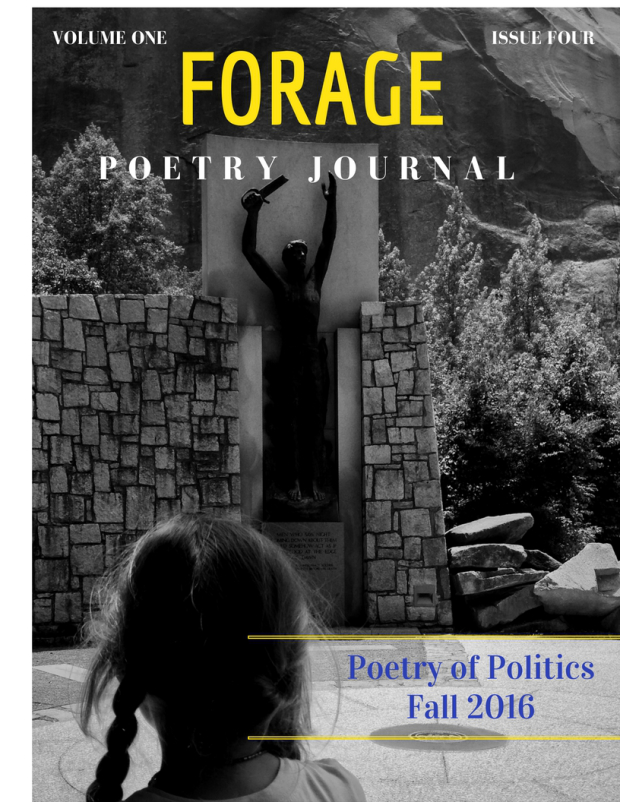
Get your own button here, and find the whole poem in November's Forage Poetry.

I found this publishing opportunity through the Duotrope Weekly Wire email.
Duotrope: an award-winning resource for writers

How I Got Published

This month, I'm fulfilling a lifelong dream - twice! But not at all the way I had planned.

In the fall of 1995, Jenn Crowell was a senior in high school at Dallastown Area High School and applying to the creative writing program at Goucher College. As her writing sample, she enclosed the manuscript of her novel. The head of the creative writing program, Madison Smartt Bell, liked it enough to send it to his agent. She liked it enough to send it to a publisher. They published Necessary Madness.
By the time Jenn got to freshman orientation, she had already sold the cable TV rights. Her story was told in the Baltimore Sun, the Portland Press Herald and across the country.

How do I know? Because family and family friends clipped the story out of their newspapers and mailed them to me (this was 1997 - people did that!) from across the country. And I saw myself in Jenn Crowell. Dallastown was our football arch-rival (though, to be honest, it was no contest; we were terrible). I took a boy from Dallastown to prom, and he spent half the night throwing up in the bathroom, poor guy, under the influence of my best friend and her boyfriend's teasing.

I also applied to Goucher College. Jenn Crowell was living my dream.